Polysomnography
Origin and history
Polysomnography originated in the United States and Western Europe in the mid-20th century. Its development is closely tied to the formalization of sleep medicine as a scientific discipline. The technique evolved from earlier, simpler studies of brain waves recorded via electroencephalography (EEG) in the 1930s and 1940s. Researchers began systematically adding other physiological measurements to the EEG during sleep in the 1950s and 1960s. The term itself, combining Greek roots for "many," "sleep," and "writing," came into standard use during this period. The creation of standardized scoring criteria for sleep stages in 1968, known as the Rechtschaffen and Kales manual, was a pivotal moment for the test's consistency.
What it is for
Polysomnography is primarily for diagnosing a range of sleep disorders by objectively recording physiological data during sleep. Its most common application is for confirming the presence and severity of obstructive sleep apnea, which involves repeated breathing interruptions. The test is also essential for diagnosing narcolepsy and idiopathic hypersomnia, often as part of a Multiple Sleep Latency Test the following day. It is used to evaluate parasomnias, such as sleepwalking or REM sleep behavior disorder, by correlating unusual behaviors with specific sleep stages. Furthermore, it can assess periodic limb movement disorder by documenting leg movements and their associated cortical arousals. It is also employed in certain cases to evaluate sleep-related seizure disorders or to titrate positive airway pressure therapy for sleep apnea.
Overview
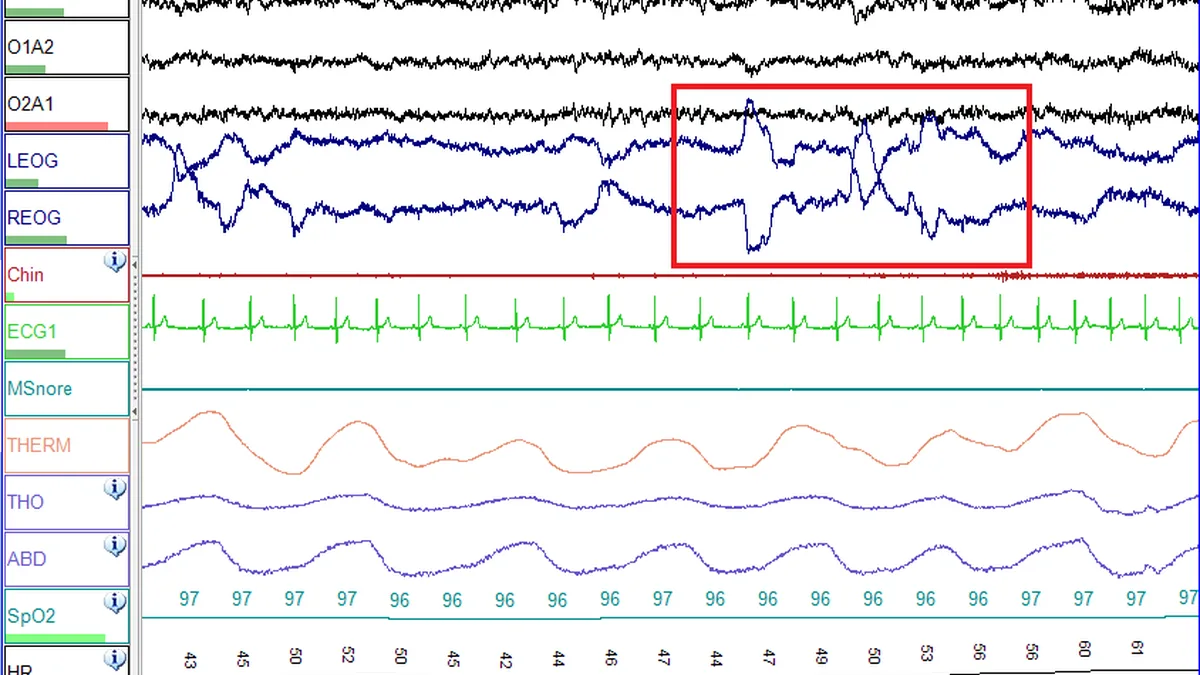
A polysomnogram is a comprehensive, overnight diagnostic test conducted in a specialized sleep laboratory. It involves the simultaneous, continuous recording of multiple physiological signals from sensors attached to the patient's body. Core measurements include brain wave activity (EEG), eye movement (EOG), and muscle tone (EMG), which together determine sleep stages and architecture. It also records respiratory effort, airflow, and blood oxygen saturation to identify breathing disturbances. Additional channels monitor heart rate (ECG) and leg muscle activity for limb movements. A trained sleep technologist supervises the study in real-time, ensuring data quality and patient safety throughout the night.
What to know
Patients undergoing polysomnography will spend a night in a private room designed to resemble a bedroom, though it is equipped with monitoring equipment. The setup process, called "hook-up," involves attaching numerous sensors with adhesive, which can take 45 to 60 minutes and may feel cumbersome. While sleeping with the sensors is unusual, most patients adapt and obtain sufficient data for diagnosis, though total sleep time may be reduced. The raw data from the study is extensive, typically comprising over 1,000 pages of graphs that must be analyzed by a technologist and interpreted by a sleep physician. A follow-up appointment is necessary to discuss the detailed findings, which form the basis for a specific diagnosis and treatment plan. It is a medically necessary diagnostic procedure, not a routine screening test, and requires a physician's referral based on clinical suspicion of a disorder.
Common questions
A common question is whether the test is painful, and while it is not painful, the sensors can feel awkward and the adhesives may irritate sensitive skin. Many ask if they will be able to sleep at all, and while sleep is often lighter and fragmented, obtaining at least several hours of data is usually sufficient for diagnosis. Patients frequently inquire about alternatives, and while home sleep apnea tests exist, they are less comprehensive and only appropriate for uncomplicated cases of suspected sleep apnea. People wonder about the accuracy, and in-lab polysomnography remains the gold standard due to the breadth of signals and technologist oversight. Questions about what to bring are common; patients are advised to bring comfortable sleepwear and any routine medications. Individuals also ask if they can use the bathroom during the night, and they can, as the technologist can temporarily disconnect the central wiring harness.
Pros and cons
A significant con is the first-night effect, where the unfamiliar environment and sensors lead to atypical sleep, potentially obscuring the usual problem or creating artifacts. Patients often regret choosing it when their symptoms are mild or non-specific, as the cost and inconvenience can feel disproportionate if the results are normal or inconclusive. A common mistake is not following pre-study instructions regarding caffeine, alcohol, or medication adjustments, which can significantly alter the data and reduce its validity. The test is also resource-intensive, requiring expensive equipment and highly trained staff, leading to long wait times for studies in many regions. Furthermore, the sheer volume of data introduces subjectivity in scoring, and even expert scorers can have minor discrepancies in interpreting events like arousals.
Who it suits
Polysomnography suits individuals with a high clinical pre-test probability of a moderate to severe sleep disorder, such as those with loud snoring, witnessed apneas, and excessive daytime sleepiness. It is essential for patients with suspected narcolepsy, parasomnias, or periodic limb movement disorder, as home tests cannot diagnose these conditions. It is also the appropriate choice for patients with significant cardiorespiratory comorbidities, like heart failure or severe COPD, where a full cardiopulmonary assessment during sleep is needed. The test suits individuals for whom a home sleep study was inconclusive, technically inadequate, or negative despite strong clinical symptoms. It is necessary for the titration of positive airway pressure devices to determine the precise therapeutic pressure required. It is generally not suited for simple screening, for individuals with insomnia as a primary complaint without other signs, or for those who cannot reasonably travel to or stay at a sleep lab.