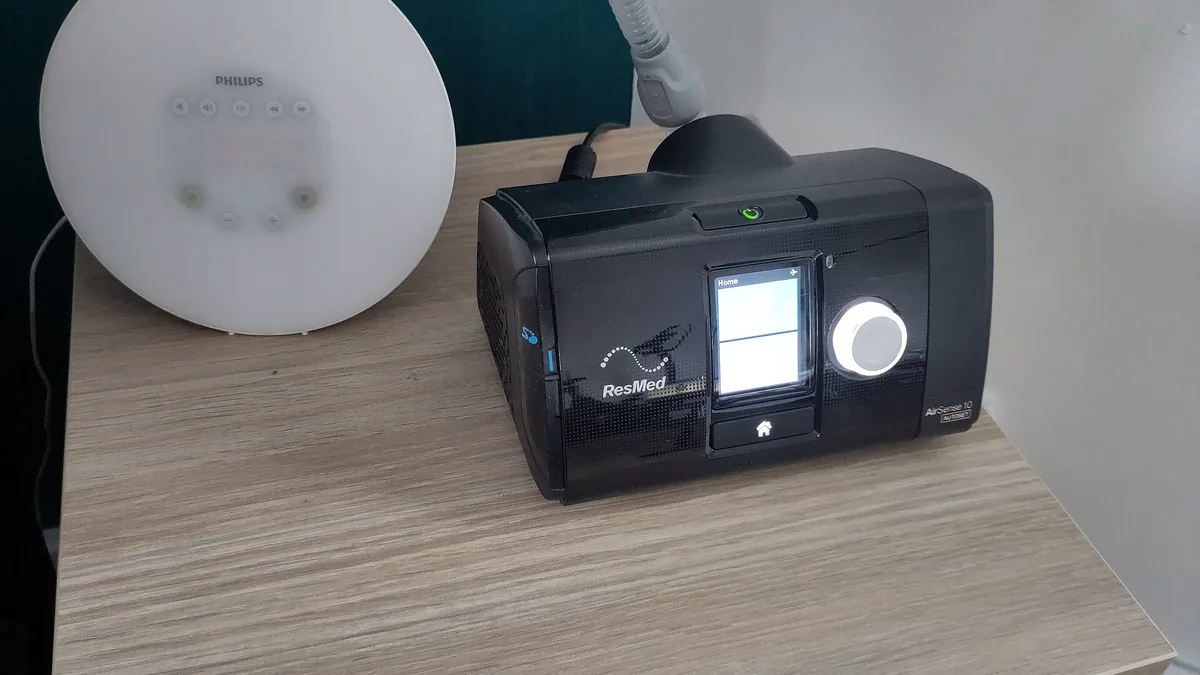
Cpap And Apap
| Device type | Positive airway pressure (PAP) therapy device |
|---|---|
| Primary function | Maintains open airway during sleep to prevent breathing pauses |
| Pressure delivery | CPAP provides constant fixed pressure; APAP provides automatically adjusting pressure within a set range |
| Primary condition treated | Obstructive sleep apnea (OSA) |
| Typical components | Motor unit, air tubing, humidifier (often integrated), mask interface |
| Original use | Treatment of sleep-disordered breathing |
Origin and history
Continuous Positive Airway Pressure (CPAP) therapy originated in Australia in the early 1980s as a treatment for obstructive sleep apnea. Dr. Colin Sullivan and his team at the University of Sydney are credited with developing the first practical CPAP device. Their work built upon existing principles of positive airway pressure used in neonatal intensive care and other respiratory support. The initial prototype was a modified vacuum cleaner motor connected to a mask, which successfully prevented airway collapse during sleep. Auto-adjusting Positive Airway Pressure (APAP) technology emerged later, in the 1990s, as microprocessor technology advanced, allowing for automated pressure adjustments throughout the night. The development of these devices transformed sleep apnea from a poorly managed condition into a treatable one, moving from hospital-based systems to portable home units over the following decades.
What it is for
CPAP and APAP devices are primarily prescribed for the treatment of obstructive sleep apnea (OSA), a disorder characterized by repeated collapse of the upper airway during sleep. Their core function is to pneumatically splint the airway open, preventing the apneas (complete pauses in breathing) and hypopneas (shallow breaths) that define the condition. By maintaining an open airway, they restore normal breathing patterns, eliminate oxygen desaturations, and prevent the associated arousals that fragment sleep. This treatment directly addresses the physiological cause of OSA, unlike other interventions that may only modify risk factors. While primarily for OSA, CPAP is also used for certain other forms of sleep-disordered breathing and occasionally for severe respiratory insufficiency. The therapy is not intended for central sleep apnea, where the brain fails to send breathing signals, unless specific advanced device modes are utilized.
Overview
A CPAP (Continuous Positive Airway Pressure) device delivers a constant, prescribed stream of pressurized air through a tube connected to a mask worn over the nose or mouth. This continuous pressure acts as a pneumatic splint to hold the throat open. An APAP (Auto-adjusting Positive Airway Pressure) device operates on a similar principle but automatically adjusts the pressure level on a breath-by-breath basis within a set range, responding to detected airway resistance, snoring, or flow limitations. Both systems consist of a motorized blower unit, a humidifier chamber (often integrated), a flexible air tube, and an interface mask. Therapy is typically prescribed for nightly use during all sleep periods, including naps, to be consistently effective. Data-capable modern devices record usage hours, residual breathing events, and mask leak metrics, allowing clinicians to objectively monitor adherence and efficacy.
What to know
A formal diagnosis of sleep apnea through a sleep study is mandatory before a CPAP or APAP device can be prescribed, as the pressure settings must be determined medically. Mask selection is critical to success; options include nasal masks, nasal pillows, and full-face masks, and finding a comfortable fit often requires trial and error. Consistent nightly use is essential, as benefits are not cumulative and symptoms return rapidly on nights without therapy. Side effects are common but often manageable and include nasal congestion, dry mouth, mask discomfort, and aerophagia (swallowing air). Device maintenance is non-negotiable and involves daily cleaning of the mask and humidifier chamber, weekly cleaning of the tubing, and regular filter replacement to ensure proper function and hygiene. Insurance coverage for the device and supplies varies widely and is typically contingent on proving adherence through machine data downloads.
Common questions
Many users ask if they will become dependent on the device, but CPAP/APAP is not addictive; it is a corrective treatment like eyeglasses, and the underlying sleep apnea remains if therapy is stopped. A frequent concern is whether the machine is too loud, but modern devices are generally very quiet, with the sound often being the user's own exhalation against the pressure. Patients often wonder if they can skip a night, but even occasional non-use leads to a return of symptoms and sleep fragmentation, negating the health benefits. The question of travel compatibility is common, and nearly all modern units are compact, include universal power adapters, and are designed for portability. Many ask if they can adjust the pressure themselves, but this is strongly discouraged as improper settings can render therapy ineffective or unsafe. Another typical inquiry is about the lifespan of a device, which is generally five to seven years with proper care before motor performance may degrade.
Pros and cons
The primary advantage of CPAP/APAP therapy is its high efficacy; when used correctly, it is the most effective treatment for eliminating obstructive sleep apnea events and their associated health risks. It is non-invasive and reversible, unlike surgical options. A significant pro is the immediate improvement in sleep quality and daytime alertness for many users. The main con is that success is entirely dependent on consistent patient adherence, which is often challenging; estimates suggest long-term non-adherence rates are substantial. Common regrets stem from initial discomfort, claustrophobia from the mask, or persistent side effects like nasal dryness that users cannot resolve, leading to abandonment of the device. A frequent mistake is not pursuing mask refittings or pressure adjustments with the clinician when problems arise, instead of simply stopping use. The therapy also ties the user to a machine every night, which can feel restrictive and complicate travel or spontaneous sleeping arrangements.
Who it suits
CPAP/APAP therapy best suits individuals with moderate to severe obstructive sleep apnea who are motivated to use the device nightly and are comfortable with technology. It is particularly well-suited for those who are not ideal candidates for other treatments, such as oral appliance therapy or upper airway surgery, due to the severity of their condition or anatomical factors. Patients who experience severe daytime sleepiness, documented oxygen desaturations, or comorbid conditions like hypertension or atrial fibrillation often derive the greatest health benefit and thus have strong motivation to adhere. It may suit people who travel frequently, given the portability of modern units, compared to more fixed surgical outcomes. Conversely, it is less suitable for individuals with extreme claustrophobia, those who cannot tolerate any facial contact during sleep, or people with frequent nasal congestion who cannot find relief with humidification or medications. It also may not be the first choice for those with very mild, asymptomatic sleep apnea where the burden of treatment may outweigh the proven benefit.
Latest Cpap And Apap news
Latest reporting
My CPAP Caddy Bedside Stand Aims to Improve Therapy
An inventor has launched an adjustable bedside stand designed to organize CPAP equipment and address common frustrations like tangled hoses and
Facial Hair Poses CPAP Mask Fitting Challenge, Survey Finds
A survey of sleep professionals finds 41% identify patients with facial hair as the hardest to fit for CPAP therapy.
NIH Grant Funds At-Home VortexPAP Development
NIH awarded AcouFlow Therapeutics a grant to develop a home version of its VortexPAP device, aiming to improve CPAP adherence with a seal-less mask.
CPAP Store USA Expands Sleep Therapy Options with Inogen Aurora CPAP Mask Line
CPAP Store USA has partnered with Inogen to offer the Inogen Aurora CPAP Mask Collection nationwide, providing consumers with a new range of...
CPAP Adherence Solutions Guide
Sleep Review's CPAP adherence solutions guide compares options for managing CPAP adherence, a crucial aspect of treating obstructive sleep apnea.